Research
Safe and Scalable Trajectory Planner for AAM Operations
Developing a trajectory planning algorithm that scales to a high number of aircraft while maintaining safety guarantees is critical for high-density airspace. This work introduces a correct-by-construction approach that combines reachability analysis and Markov decision processes to achieve safe and scalable real-time trajectory planning.
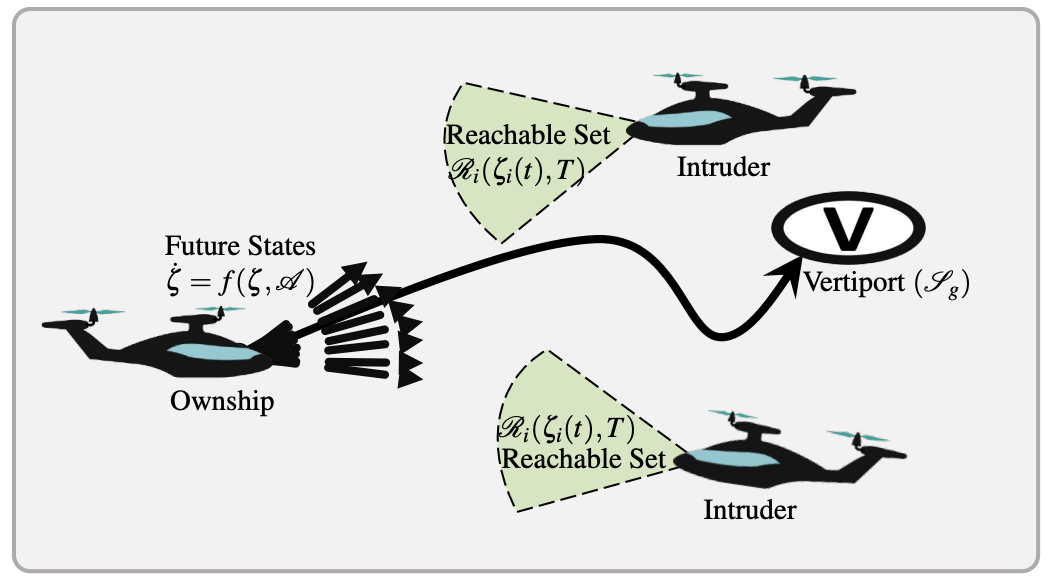
- A. G. Taye, J. Bertram, C. Fan, P. Wei. "Reachability based Online Safety Verification for High-Density Urban Air Mobility Trajectory Planning". AIAA AVIATION 2022 Forum.
- A. G. Taye, R. Valenti, A. Rajhans, A. Mavrommati, P. J. Mosterman, P. Wei. "Safe and Scalable Real-Time Trajectory Planning Framework for Urban Air Mobility". Journal of Aerospace Information Systems (JAIS), 21 (8), 641-650, 2024.
In-Time Safety Management of AAM Operations
Ensuring the safety of AAM operations requires assessing hazards that affect the safety of the flight mission pre-departure. This project introduces an energy-efficient trajectory planner and a model-based prognostics approach to assess the risk that arises from insufficient battery energy and other environmental factors such as winds.
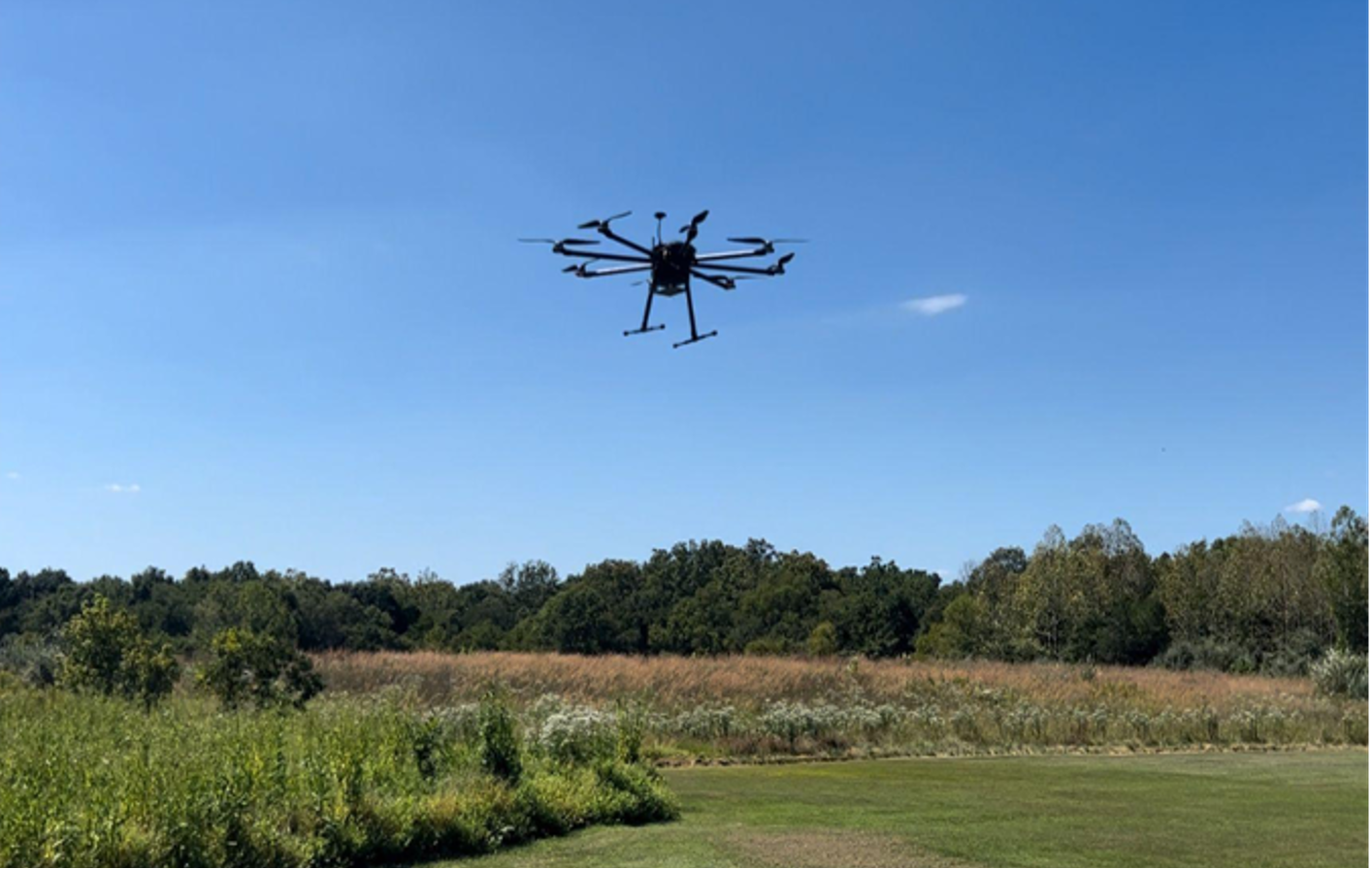
- A. Taye, E. L. Thompson, P. Wei, T. Bonin, J. C. Jones. "Probabilistic Evaluation for Flight Mission Feasibility of a Small Octocopter in the Presence of Wind". AIAA AVIATION 2023 Forum.
- A. G. Taye, P. Wei. "Flight Mission Feasibility Assessment of Urban Air Mobility Operations Under Battery Energy Constraint". AIAA SCITECH 2024 Forum.
- E. L. Thompson, A. G. Taye, W. Guo, P. Wei, M. Quinones, I. Ahmed, G. Biswas, J. Quattrociocchi, S. Carr, U. Topcu, J. C. Jones, M. W. Brittain. "A Survey of eVTOL Aircraft and AAM Operation Hazards". AIAA Aviation 2022 Forum.
- A. G. Taye, P. Wei. "Energy-Efficient Trajectory Planning and Feasibility Assessment Framework for Drone Package Delivery". Journal of Aerospace Information Systems, 2025.
Securing High-Density Urban Airspaces
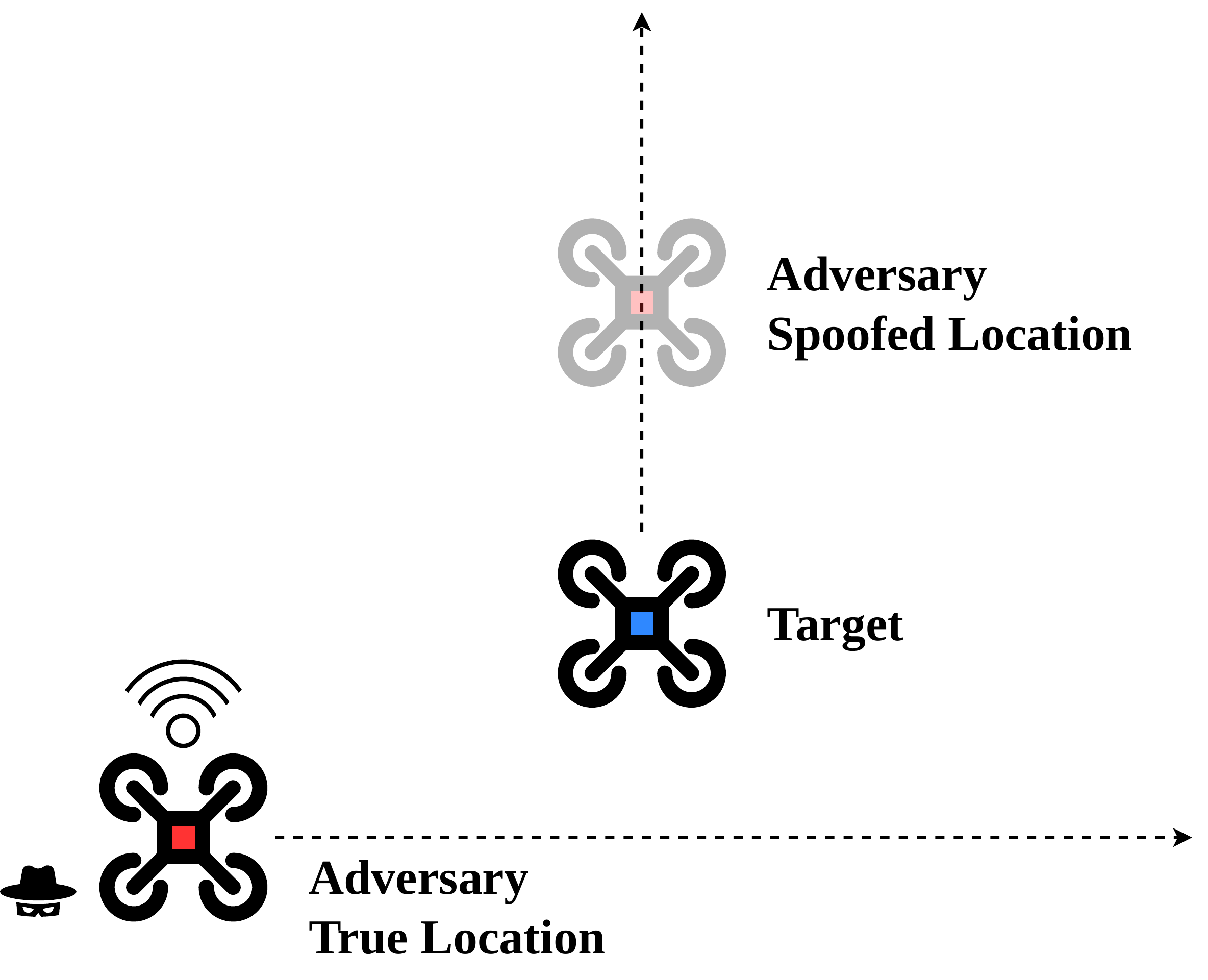
As AAM operations become increasingly networked and autonomous, cybersecurity emerges as a fundamental safety concern. In this work, I develop methods and algorithms to identify vulnerabilities in AAM systems and design defense strategies against cyberattacks to improve system-level resilience and security.
- M. Ghazanfari, I. Sharifi, P. Wei, A. Taye, A. Diaz-Gonzalez, A. Coursey, B. Bjorkman, R. E. Canady, B. Ward, G. Biswas, X. Koutsoukos. "A Survey of Security Challenges and Solutions for Advanced Air Mobility and eVTOL Aircraft".AIAA SCITECH 2026 Forum.
- I. Sharifi, M. Ghazanfari, A. Taye, P. Wei, A. Diaz-Gonzalez, A. Coursey, B. Bjorkman, R. E. Canady, B. Ward, G. Biswas, X. Koutsoukos. "A Survey of Security Challenges and Solutions for UAS Traffic Management (UTM) and small Unmanned Aerial Systems (sUAS)".AIAA SCITECH 2026 Forum.
- A. Diaz-Gonzalez, A. Coursey, B. Bjorkman, D. Shatokhin, C. Lemieux-Mack, N. W. Dahle, R. E. Canady, A. Taye, X. Koutsoukos, G. Biswas, B. Ward. "Networked Simulation for Cybersecurity Evaluation of Small Unmanned Aircraft Systems in Dense Urban Environments".AIAA SCITECH 2026 Forum.
- N. W. Dahle, R. E. Canady, A. Coursey, A. Diaz-Gonzalez, C. Lemieux-Mack, B. Bjorkman, A. Taye, B. Ward, G. Biswas, X. Koutsoukos. "Detection of Compromised UAVs using Graph Machine Learning". AIAA SCITECH 2026 Forum.
- B. Bjorkman, S. Zheng, A. Coursey, C. Lemieux-Mack, S. Gonzalez, A. Diaz-Gonzalez, N. W. Dahle, N. Koroma, R. E. Canady, X. Koutsoukos, G. Biswas, A. Taye, B. Ward. "Remote ID Spoofing Attacks and Defenses". AIAA SCITECH 2026 Forum.
Real-Time Flight Mission Feasibility Assessment
Ensuring flight safety for small unmanned aerial systems (sUAS) requires continuous in-flight monitoring and decision-making, as unexpected events can occur during flight. In this work, we present an online feasibility assessment and contingency management framework that continuously monitors the aircraft's battery state and the energy required to complete the flight in real-time.
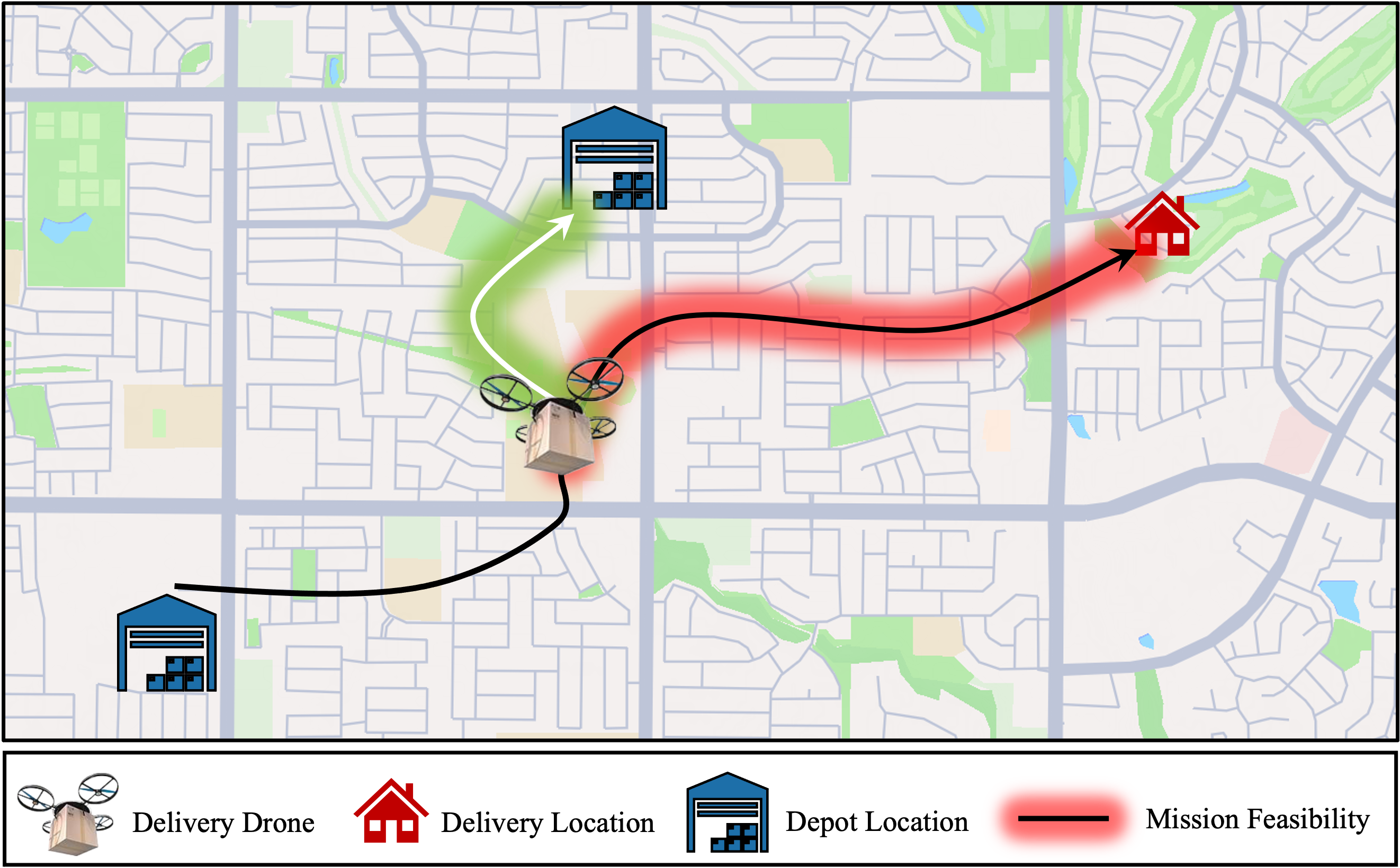
- A. Taye, A. Coursey, M. Quinones-Grueiro, C. Hu, G. Biswas, P. Wei. "Safe to Fly? Real-Time Flight Mission Feasibility Assessment for Drone Package Delivery Operations".36th International Conference on Principles of Diagnosis and Resilient Systems (DX 2025).
Energy-Aware Strategic Traffic Management for UAM
We propose a strategic traffic management framework that explicitly accounts for the energy constraints of electric vertical take-off and landing (eVTOL) vehicles. By integrating energy consumption models into the traffic flow management process, we ensure that flights are not only de-conflicted but also operate within safe energy margins.
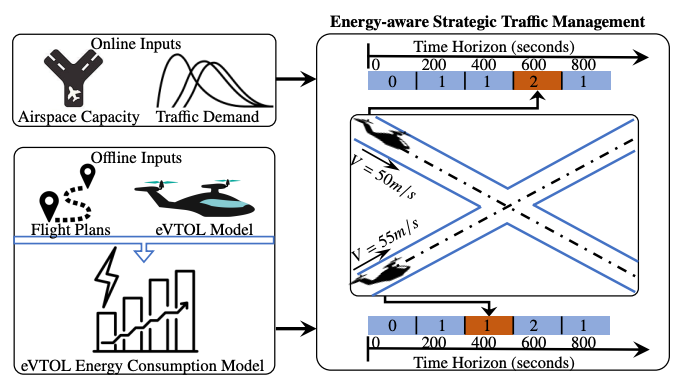
- A. G. Taye, S. Chen, P. Wei. "Energy-Aware Strategic Traffic Management for Urban Air Mobility". AIAA SCITECH 2025 Forum.
Energy Demand Analysis for eVTOL Charging Stations in UAM
Understanding the energy infrastructure requirements is critical for the successful deployment of urban air mobility. This work analyzes the electrical load requirements for eVTOL charging stations, considering flight frequency, vehicle turnaround times, and battery characteristics to inform grid integration planning and ensure reliable operations.
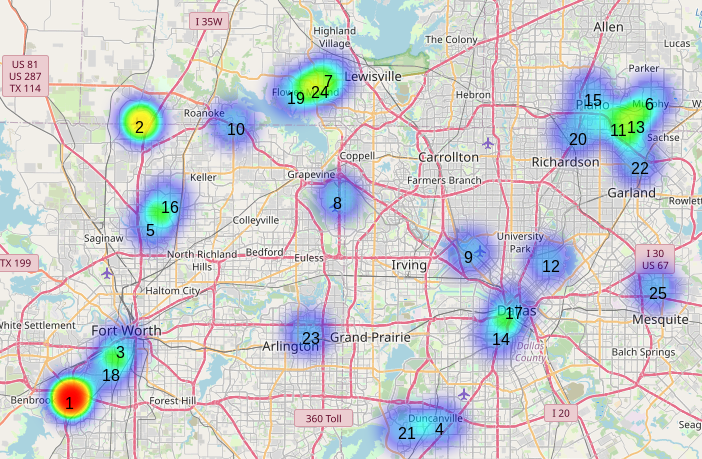
- A. G. Taye, P. Pradeep, P. Wei, J. C. Jones, T. Bonin, D. Eberle. "Energy Demand Analysis for eVTOL Charging Stations in Urban Air Mobility".AIAA AVIATION FORUM AND ASCEND 2024.